
Heat Adaptation Training
Why It Works, How to Do It, and How to Use It Without Compromising Training
TL;DR — Key Takeaways
Heat adaptation improves performance, comfort, and safety in hot conditions by improving thermoregulation and cardiovascular stability, including earlier sweating, higher sweat rates, reduced sodium concentration in sweat, and plasma volume expansion¹²
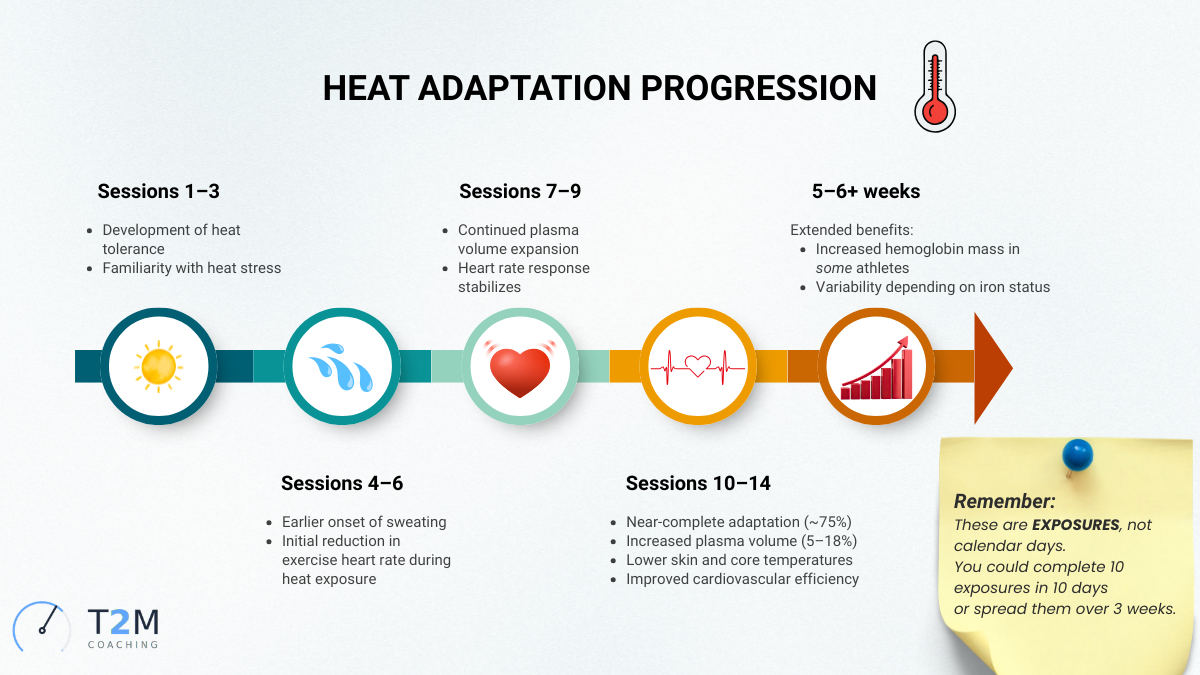
Initial (measurable) adaptations typically begin within ~4–6 heat exposures, while near-complete adaptation usually requires ~10–14 total exposures³⁴; some evidence suggests women may require slightly more exposure on average⁵⁶
Longer heat-adaptation protocols (≈5+ weeks) may increase hemoglobin mass in some athletes, though responses are variable and the evidence base is smaller than for heat tolerance itself⁷⁸
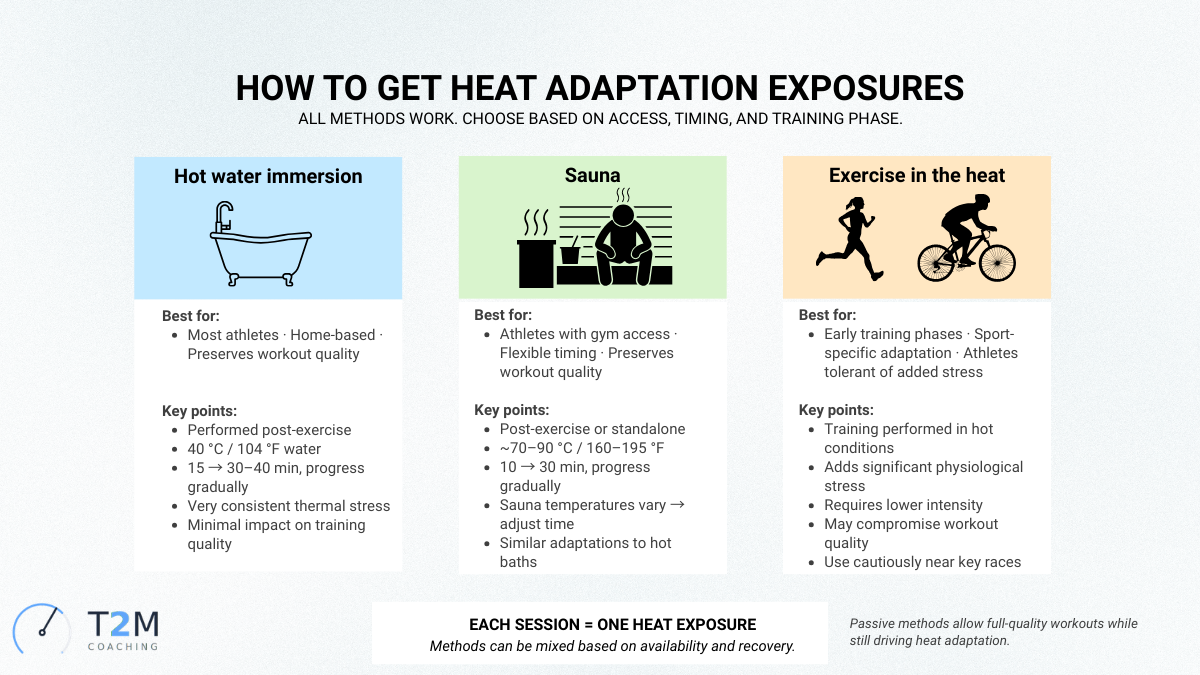
Heat adaptation can be achieved through hot baths, sauna exposure, or training in the heat, provided total heat exposure and recovery are managed appropriately⁹¹⁰
Safety, hydration, and gradual progression are essential¹¹
Why Do Heat Adaptation Training?
Heat adaptation improves the body’s ability to manage thermal, cardiovascular, and perceptual strain during exercise in warm environments. Without adaptation, exercising in the heat creates competing demands: blood must be delivered to working muscles while also being redirected to the skin for cooling. This elevates heart rate, accelerates dehydration, and increases perceived effort.
Heat adaptation reduces these constraints through several well-established physiological changes.
Primary, Well-Supported Adaptations
Thermoregulation
Earlier onset of sweating
Higher sweat rates
Heat adaptation reduces the sodium concentration of sweat; however, total sodium loss still depends on individual sweat rate and event duration¹
Practical note: While athletes lose less sodium per liter of sweat, total sodium needs may remain unchanged—or even increase—because sweat volumes are typically higher once adapted.
Cardiovascular
Plasma volume expansion (≈5–18%)²³
Lower heart rate at the same workload in the heat¹²
Improved distribution of blood flow between muscles and skin¹
Together, these adaptations reduce cardiovascular strain, stabilize pacing, and lower the risk of heat-related performance decline.
Can Heat Adaptation Help Outside of Hot Conditions?
Plasma volume expansion improves cardiovascular efficiency and can support small performance benefits in some athletes even in cooler environments²³.
With longer heat-adaptation protocols (≈5–6+ weeks), some studies report modest increases in hemoglobin mass⁷⁸. The proposed mechanism is that rapid plasma volume expansion temporarily dilutes hematocrit, stimulating erythropoietin release and subsequent red blood cell production⁸.
Important context:
Responses vary widely between individuals
Adequate iron status and training load matter
Short protocols primarily affect plasma volume, not red blood cells
Evidence for these longer-term effects exists, but is more limited than for heat tolerance itself
Heat adaptation should therefore be viewed primarily as a tool for performing better in the heat, with possible secondary benefits in some athletes.
How to Do Heat Adaptation (Before Choosing a Method)
1. Think in Terms of “Heat Exposures,” Not Days
Heat adaptation depends primarily on the number of meaningful heat exposures, not calendar time³⁴.
~4–6 exposures: initial (measurable) adaptation begins
~10–14 exposures: near-complete adaptation for most athletes³⁴
Adaptations persist for ~1–2 weeks and can be maintained with periodic exposure¹²
2. Progress Gradually
Heat adaptation adds real physiological stress.
Start with shorter, easier exposures
Build duration or severity gradually
Avoid stacking maximal training stress and maximal heat stress early¹¹
3. Hydration Matters More Than Maximizing Heat Stress
Begin sessions well hydrated
Drinking fluids during heat exposure does not appear to blunt adaptation¹¹
Dehydration increases cardiovascular strain and risk without adaptive benefit¹
4. Mixing Heat-Adaptation Methods
In practice, athletes often mix heat-adaptation methods. While this has not been studied directly, each session represents a thermal “dose,” and substituting one method for another is a reasonable, pragmatic approach when total exposure and recovery are managed appropriately.
5. Sex Differences in Heat Adaptation
Some research suggests sex-related differences in heat-adaptation timelines may exist, with females on average sometimes requiring more heat exposure to achieve comparable physiological changes⁵⁶.
Important context:
Females remain under-represented in heat-acclimation research⁵
When matched for fitness, body size, and acclimatization status, differences may be smaller or absent⁵
Mechanisms are not fully understood
Individual variability is large in both sexes
Coach’s Note:
Women adapt just as effectively as men, but some may benefit from a few additional heat exposures.
Some evidence also suggests heat tolerance may fluctuate across the menstrual cycle—particularly during the luteal phase, when baseline core temperature is slightly higher. Individual monitoring remains the most practical approach.
Method 1: Post-Exercise Hot Water Immersion (Hot Baths)
Why It Works
Water transfers heat far more efficiently than air, producing rapid and reliable increases in thermal strain⁹.
Protocol (Progressive & Evidence-Based)
Water temperature: ~40 °C / 104 °F
Timing: Immediately post-exercise (preferred)
Start: 15–20 minutes
Progression: +5 minutes per session
Target: 30–40 minutes
Total exposures: ~6–10 over ~10–14 days⁹¹⁰
Coach’s Notes:
Hot showers: No controlled studies have examined hot showers for heat adaptation. They may provide inconsistent heat stimulus due to evaporative cooling and uneven exposure. Better than nothing, but inferior to immersion.
Hydration: Sweat rates remain high in hot baths. Enter hydrated and consider sipping fluids during longer sessions.
Temperature: Increasing water temperature above ~40 °C (104 °F) is not recommended. Higher temperatures increase risk without clear added benefit.
Method 2: Sauna-Based Heat Adaptation
Traditional Dry Sauna (Most Studied)
Temperature: ~70–90 °C / 160–195 °F
Start: 10–15 minutes
Progression: Build toward 20–30 minutes
Total exposures: ~10–14³⁴
Sauna-based protocols have been shown to expand plasma volume and improve endurance performance¹²¹³.
Coach’s Notes:
Temperature control: Gym saunas may run cooler or be fixed; lower temperatures may require longer duration.
Heart rate as a proxy: Some athletes find HR useful as an individual indicator of rising thermal strain. It is not a dosing target, but can help identify accumulating heat stress.
Hydration: Stay hydrated; insulated bottles help keep fluids cooler.
Method 3: Heat Adaptation During Exercise
Training directly in hot environments can induce heat adaptation but adds to total training stress¹⁰¹⁴.
Beginner-Appropriate Progression
Environment: Start ~28–30 °C (82–86 °F), progress toward ~35 °C (95 °F)
Intensity: Low–moderate (≈50–60% VO₂max)
Start duration: 30–45 minutes
Progression: Build toward 60–90 minutes
Total exposures: ~10–14¹⁴
Coach’s Notes:
Increasing core temperature during exercise adds to total workout stress and may compromise workout quality.
Best used earlier in training phases, not close to races.
Passive heat exposure preserves workout quality while still driving adaptation.
Practical Summary
For most endurance athletes preparing for hot conditions:
Plan heat adaptation in terms of total exposures, not days
Expect initial adaptation within ~4–6 sessions and near-complete adaptation by ~10–14
Monitor individual responses rather than relying on rigid assumptions
Choose the method that best fits logistics and recovery
Prioritize safety, hydration, and gradual progression
Use heat adaptation to support training, not replace it
References
Périard JD, Eijsvogels TMH, Daanen HAM. (2021).
Exercise under heat stress: thermoregulation, hydration, performance implications, and mitigation strategies.
Physiological Reviews, 101(4), 1873–1979.
https://journals.physiology.org/doi/full/10.1152/physrev.00038.2020Racinais S et al. (2017).
Heat acclimation has a protective effect on the central but not peripheral nervous system.
Journal of Applied Physiology.
https://journals.physiology.org/doi/full/10.1152/japplphysiol.00430.2017Garrett AT et al. (2019).
Time course of heat acclimation and decay in trained athletes.
Journal of Sports Sciences.
https://pure.coventry.ac.uk/ws/portalfiles/portal/53721953/Published.pdfTyler CJ et al. (2016).
The time course of heat acclimation decay.
Journal of Applied Physiology.
https://journals.physiology.org/doi/full/10.1152/japplphysiol.00550.2015Wickham KA et al. (2021).
Sex differences in the physiological adaptations to heat acclimation.
European Journal of Applied Physiology.
https://pubmed.ncbi.nlm.nih.gov/33205218/Kirby NV et al. (2019).
Nine-, but not four-day heat acclimation improves self-paced endurance performance in females.
Frontiers in Physiology.
https://www.frontiersin.org/articles/10.3389/fphys.2019.00539/fullOberholzer L et al. (2019).
Hematological adaptations to prolonged heat acclimation in endurance-trained males.
Frontiers in Physiology.
https://www.frontiersin.org/articles/10.3389/fphys.2019.00137/fullMontero D, Lundby C. (2018).
Regulation of red blood cell volume with exercise training.
Sports Medicine.
https://pubmed.ncbi.nlm.nih.gov/30549016/Zurawlew MJ et al. (2016).
Post-exercise hot water immersion induces heat acclimation and improves endurance performance.
Scandinavian Journal of Medicine & Science in Sports.
https://onlinelibrary.wiley.com/doi/10.1111/sms.12638McIntyre JP et al. (2021).
Medium-term heat acclimation by hot water immersion or exercise in the heat.
American Journal of Physiology – Regulatory, Integrative and Comparative Physiology.
https://journals.physiology.org/doi/full/10.1152/ajpregu.00315.2021Kenefick RW. (2018).
Drinking strategies during exercise in the heat.
Journal of Applied Physiology.
https://pubmed.ncbi.nlm.nih.gov/29368181/Scoon GSM et al. (2007).
Post-exercise sauna bathing improves endurance performance.
Journal of Science and Medicine in Sport.
https://www.researchgate.net/publication/6909623_Effect_of_post-exercise_sauna_bathing_on_the_endurance_performance_of_competitive_male_runnersCastle P et al. (2011).
Short-term heat acclimation improves intermittent-sprint performance.
International Journal of Sports Physiology and Performance.
https://pubmed.ncbi.nlm.nih.gov/21777052/Lorenzo S et al. (2010).
Heat acclimation improves exercise performance.
Journal of Applied Physiology.
https://journals.physiology.org/doi/full/10.1152/japplphysiol.00267.2010